
Honest insurance claim guidance
Content should explain the claims process accurately without suggesting damage should be exaggerated or misrepresented to an adjuster, keeping the contractor's role clearly advisory rather than directive.

Roofing
Most homeowners buy a roof once and never again. Trust, timing, and the insurance process decide almost everything about how that purchase happens.
The vertical
Roofing demand is unusually concentrated around storm events. A significant hailstorm can generate more roofing search volume in a Colorado market in a single week than the rest of the year combined, and that concentration creates both an opportunity and a real cost problem, since paid media prices in that same category spike sharply the moment every other roofer in the region starts bidding on the same storm-driven keywords at the same time.
Because so much roofing work in hail-prone regions is insurance-funded, the sales conversation is not really about price, it is about the insurance claim process. Homeowners want a contractor who understands how adjusters evaluate damage, how to document it properly, and how to navigate a claim without creating problems with the insurer. A roofing company's marketing needs to speak fluently to this process, because a homeowner choosing between two similar-looking contractors will often choose the one whose content or sales conversation demonstrates real claim experience.
Storm-driven demand also attracts storm chasers, contractors who appear after a hail event, sell aggressively, and sometimes disappear before warranty issues surface. This pattern has damaged trust across the entire category, which means established local roofing contractors have to work harder to differentiate on licensing, permanent local presence, and verifiable warranty terms than contractors in most other home trades.
Because a roof is a high-ticket purchase made once, maybe twice, in a homeowner's time in a house, there is no repeat purchase to build a business on. Referrals, reviews, and reputation compounding over years are what actually build a sustainable roofing business, which makes long-term reputation management and review generation a bigger strategic priority here than the immediate transaction economics of any single job.
Demand behaviour
Roofing search behavior is dominated by storm timing, insurance claim questions, and trust verification before a large purchase.
In the days and weeks after a significant hailstorm, search volume for roof inspection and roof repair spikes sharply in the affected area, and much of it is genuinely urgent since homeowners are worried about leaks and further damage. This period also brings a wave of searches for how the insurance claim process works, since many homeowners have never filed a roofing claim before.
Outside of storm windows, roofing searches are slower and more research-driven, often triggered by a visible leak, an aging roof nearing the end of its expected life, or a home sale inspection that flagged a problem. These searchers have more time to compare contractors, read reviews carefully, and ask about licensing and warranty terms before committing.
Trust verification runs through both patterns. Because the purchase is large and infrequent, homeowners look for license numbers, local business history, insurance credentials, and manufacturer certifications before calling, and they are increasingly aware of storm chaser patterns, which makes proof of permanent local presence a real differentiator in search content.
Constraints
Roofing marketing has to be scrupulously honest about insurance claims, licensing, and warranty terms given how much trust damage storm chasers have caused the category.
Content and sales conversations that discuss insurance claims need to avoid anything that could be read as encouraging inflated claims or misrepresenting damage, since this is both an ethical issue and, in many jurisdictions, a regulated one. Contractors should help homeowners understand the claims process without positioning themselves as directing the insurer's decision.
Licensing, insurance, and manufacturer certification claims need to be accurate and easy to verify, since one of the clearest ways to differentiate from storm chaser competition is demonstrable, checkable local legitimacy. Warranty terms in particular should be described precisely, since ambiguity here is a common source of homeowner disputes years after installation.
Content should explain the claims process accurately without suggesting damage should be exaggerated or misrepresented to an adjuster, keeping the contractor's role clearly advisory rather than directive.
Claims about licensing, years in business, and local address should be accurate and easy to confirm, since this is a primary way to differentiate from storm chaser competitors after a hail event.
Warranty terms, including what is covered by the manufacturer versus the contractor's own workmanship warranty, should be stated precisely to avoid disputes long after the roof is installed.
Marketing and sales messaging should avoid urgency tactics that pressure homeowners into signing immediately after a storm, since this pattern is closely associated with the storm chasers the category is trying to be distinguished from.
Where the leverage is
We run nine pillars. These are the ones that move this vertical, and the reason each one earns its place.
Paid search cost per click in roofing rises dramatically in the days after a storm as every regional contractor bids on the same terms simultaneously, so campaigns need pre-built creative and bidding strategy ready to deploy fast without overpaying.
Explore Paid MediaOrganic visibility for insurance claim guidance and local trust content is not subject to the same storm-driven bidding spike as paid media, making it a more cost-stable way to capture demand during and after peak storm windows.
Explore SEOHomeowners ask direct, high-stakes questions about the insurance claim process, and being the extractable answer to those questions builds trust with a buyer before they have even identified a shortlist of contractors.
Explore AEOBefore-and-after project documentation and review-driven content compound reputation over years in a category with no repeat purchase, making an ongoing social presence a long-term trust asset rather than a short-term lead channel.
Explore SocialOften yes, if the damage meets the insurer's threshold and is documented properly, but coverage depends on the specific policy, the extent of the damage, and the insurer's own inspection. A reputable roofer can help document damage but the insurer makes the final coverage decision.
Conversion
Roofing conversion depends on trust signals and claim-process clarity more than price, especially in the chaotic period right after a storm.
In the days after a hailstorm, homeowners are choosing between multiple contractors who all showed up around the same time, and the decision often comes down to who feels most credible and least like a storm chaser. Clear licensing information, real local history, and a calm explanation of the insurance process differentiate a legitimate contractor from an opportunistic one in that moment.
Outside storm windows, conversion depends more on visual proof of past work and reviews, since a homeowner replacing an aging roof on their own timeline has the time to research thoroughly. Because there is no repeat purchase to fall back on, every completed project's review and referral potential matters disproportionately to long-term growth.
Clear, honest explanations of how the claims process works build trust with homeowners navigating an unfamiliar and stressful process, and this content often converts better than pure sales messaging in the storm window.
License numbers, years in business, local address, and manufacturer certifications displayed prominently help a homeowner distinguish a legitimate local contractor from a storm chaser within seconds of landing on a page.
Before-and-after photos and detailed reviews carry more weight in roofing than in most trades because the purchase is infrequent and homeowners have limited personal experience to judge quality against.
Since a homeowner will likely never buy another roof from the same company, structured requests for reviews and referrals after project completion are the primary way this category compounds growth over time.
Live work
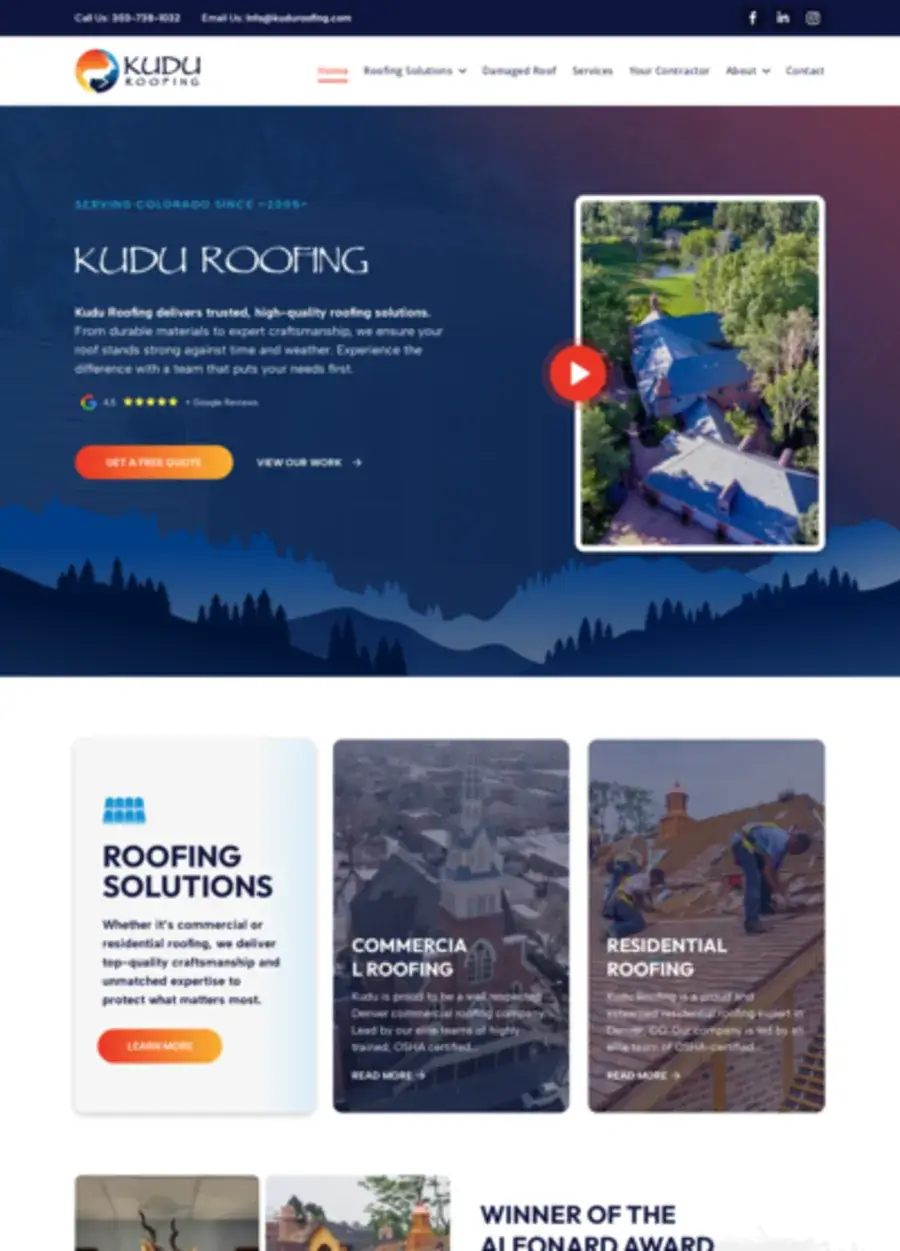
Real properties, running in production. Click any of them and judge the work directly.
Questions
Adjacent verticals
These verticals share buying cycles, trust signals, or local search behaviour, so the programs borrow from each other.
Local
Our office is at 400 E Simpson St in Lafayette, and most of this work runs across the Denver and Boulder metros.
Vertical strategy and local strategy are the same project once a business has a service area. The mechanics on this page decide what a page says. The location tier decides where it competes, and local SEO handles proximity, prominence, and relevance as three separate levers.
Lafayette, Colorado. Serving the Denver metro, the Boulder Valley, and Northern Colorado.
Start with a diagnosis. You get the roadmap and the quote before anyone builds anything.