
Listing accuracy across platforms
Hours, address, phone number, and open or closed status must match exactly across every platform a customer might check, since a single wrong listing can cost a booking with no chance to correct the impression.

Restaurant growth
Someone deciding where to eat tonight makes that decision in minutes. We build the accuracy and content that wins that window.
The vertical
Restaurant search happens on an entirely different clock than most other categories. A person deciding where to eat is often making that decision within minutes, standing outside, hungry, on a phone, and the businesses that win that moment are the ones whose basic information is correct and whose presence shows up first. There is very little room for a slow-loading site or an out-of-date hours listing in a decision window this short.
Nothing matters more in that moment than map pack accuracy. Hours, current status as open or closed, phone number, and address need to be correct everywhere they appear, because a wrong hour or a stale closure notice sends a hungry customer straight to a competitor with no second chance. This is a category where operational accuracy functions as marketing, not a separate concern from it.
Once someone has found the restaurant, the menu is the single most requested piece of content on the entire site, more than the about page, the reservation page, or any promotional content combined. People want to know what is available, roughly what it costs, and whether it fits dietary needs before they commit to walking in or placing an order, and a menu that is hard to find or out of date actively costs bookings.
The economics of the category are squeezed from multiple directions at once. Reservation and online ordering platforms take a cut or a fee for the convenience they provide, third party delivery services take a further and often significant share of order value, and margins in food service are thin to begin with, which limits how much can realistically be spent on paid media. Photography, social content, and review management become the highest-leverage channels precisely because they cost time rather than large ad budgets.
Demand behaviour
Restaurant searches are immediate, mobile, and local, with decisions often made in the minutes surrounding the search itself.
The dominant search pattern is proximity and category combined with urgency, things like a cuisine type plus near me, or a specific dish craving paired with a neighborhood. These searches happen overwhelmingly on mobile devices, frequently while someone is already out and hungry, and the results that load fastest with the clearest information win regardless of how good the food actually is.
There is very little of the long research phase seen in other categories. Most restaurant searches move from query to decision within a single short session, which means the map pack listing, the menu, and recent reviews all need to be visible and convincing within seconds, not laid out across a multi-page site that expects a leisurely browse.
Review recency carries unusual weight in this category compared to others, because food quality and service can genuinely vary week to week, and a customer checking reviews wants to know how the place is doing lately, not two years ago. A restaurant with strong older reviews but a recent quiet or negative stretch can lose bookings even with a high overall average rating.
Constraints
Thin margins and third party platform dependence limit media budgets and shape which channels are actually worth investing in.
Food service margins leave little room for expensive, slow-to-prove marketing programs, which means every dollar spent needs a fairly direct line to bookings or orders. This pushes the category toward channels that compound over time, like accurate local listings, organic content, and review management, rather than channels that require sustained heavy spend.
Dependence on reservation and delivery platforms also means a restaurant's own site and direct channels need to earn a share of demand that would otherwise flow entirely through a fee-taking intermediary, and that requires making the direct path genuinely easier or more appealing, not just present.
Hours, address, phone number, and open or closed status must match exactly across every platform a customer might check, since a single wrong listing can cost a booking with no chance to correct the impression.
Menu items, descriptions, and prices shown online need to reflect what is currently offered, since customers make same-day decisions based on this information and discover mismatches immediately in person.
Food photography should represent portions and presentation accurately, since a gap between the photo and the plate shows up in reviews within days.
Recent reviews, especially negative ones, deserve a prompt and genuine response, since review recency and sentiment shift quickly and an unanswered complaint sits visible to every new searcher.
Where the leverage is
We run nine pillars. These are the ones that move this vertical, and the reason each one earns its place.
Map pack ranking and listing accuracy are the single highest-leverage lever in this category, since most decisions are made from local search results within minutes.
Explore SEOFood photography and short-form video are the primary discovery channel for a category where visual appeal drives the decision more than written description ever could.
Explore SocialDirect questions about hours, dietary options, and menu items are answered instantly by AI-driven search, and accurate structured content wins that answer slot.
Explore AEOWith thin margins, understanding which channel actually drives a booking or an order, rather than just traffic, is essential to spending the limited budget well.
Explore AnalyticsConsistently accurate hours, address, and phone number across every listing platform matter more than almost anything else, since customers make near-instant, hungry decisions and a single wrong detail sends them to a competitor.
Conversion
A completed reservation or a placed order is the only outcome restaurant marketing should be judged against.
Because the decision window is so short, friction anywhere in the path from search result to booked table or placed order costs real revenue. A reservation button that is one extra click away, or a menu that requires a download, loses customers who simply move to the next result.
Encouraging direct orders and direct reservations, rather than routing every customer through a fee-taking third party platform, protects margin meaningfully over time, and that requires making the direct path at least as easy and as visible as the platform listing.
Photography and recent, well-managed reviews do more to convert an undecided searcher than any promotional offer, because in a category decided in minutes, visual appeal and recent proof of a good experience are the fastest ways to build confidence.
Reservation and ordering links need to be immediately visible and require minimal steps, since a customer deciding in minutes will abandon anything that feels slow or unclear.
The menu should be the easiest thing to find on the site, shown as readable text rather than a hard to scan image or a slow-loading download.
Modest incentives for ordering directly rather than through a delivery platform help recover margin lost to third party fees without requiring a large marketing spend.
Prompt, genuine responses to recent reviews, especially negative ones, protect the sentiment that new searchers see first and directly affect booking decisions.
Live work
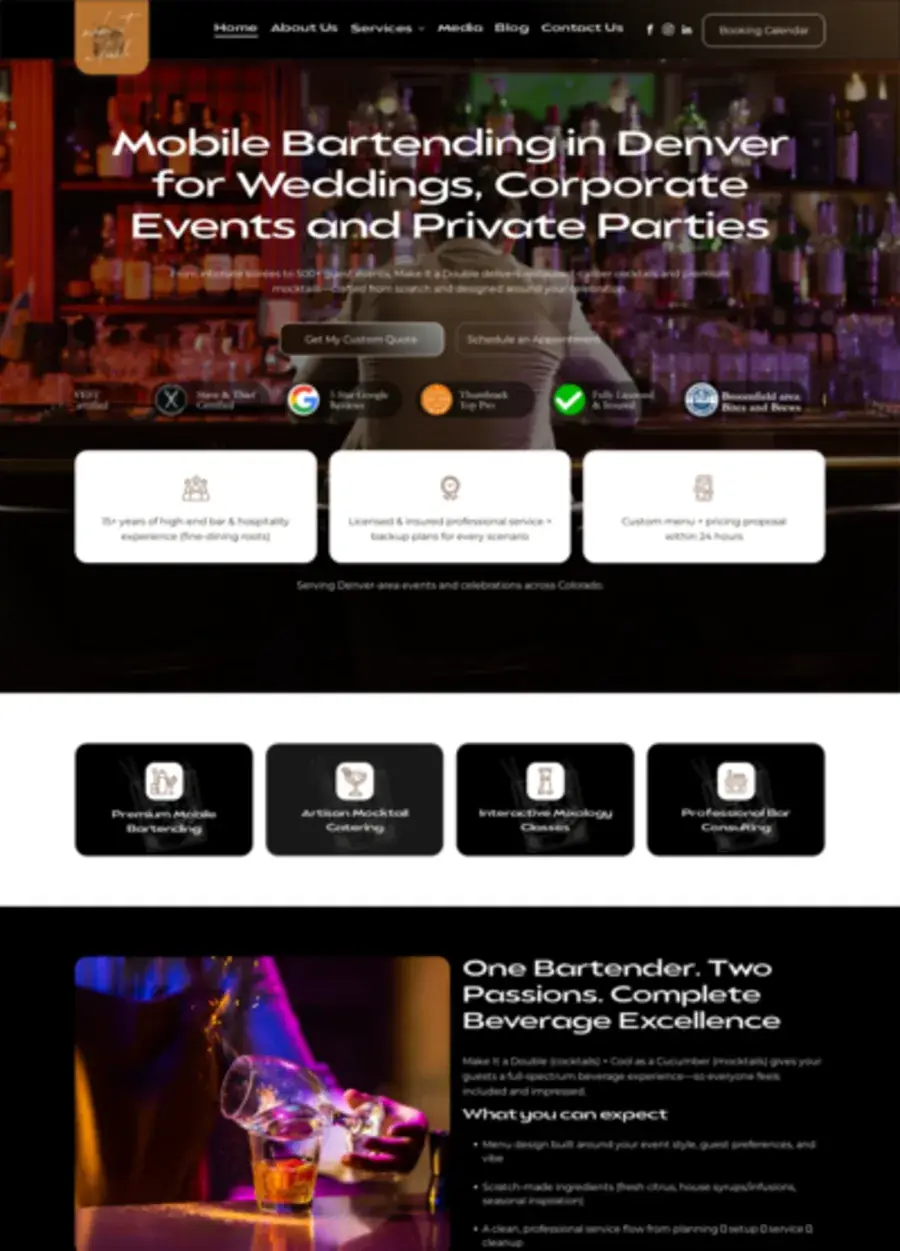
Real properties, running in production. Click any of them and judge the work directly.
Questions
Adjacent verticals
These verticals share buying cycles, trust signals, or local search behaviour, so the programs borrow from each other.
Local
Our office is at 400 E Simpson St in Lafayette, and most of this work runs across the Denver and Boulder metros.
Vertical strategy and local strategy are the same project once a business has a service area. The mechanics on this page decide what a page says. The location tier decides where it competes, and local SEO handles proximity, prominence, and relevance as three separate levers.
Lafayette, Colorado. Serving the Denver metro, the Boulder Valley, and Northern Colorado.
Start with a diagnosis. You get the roadmap and the quote before anyone builds anything.